Hercules DJControl T10 Review: 10-Inch Motorized Platters for $1,399
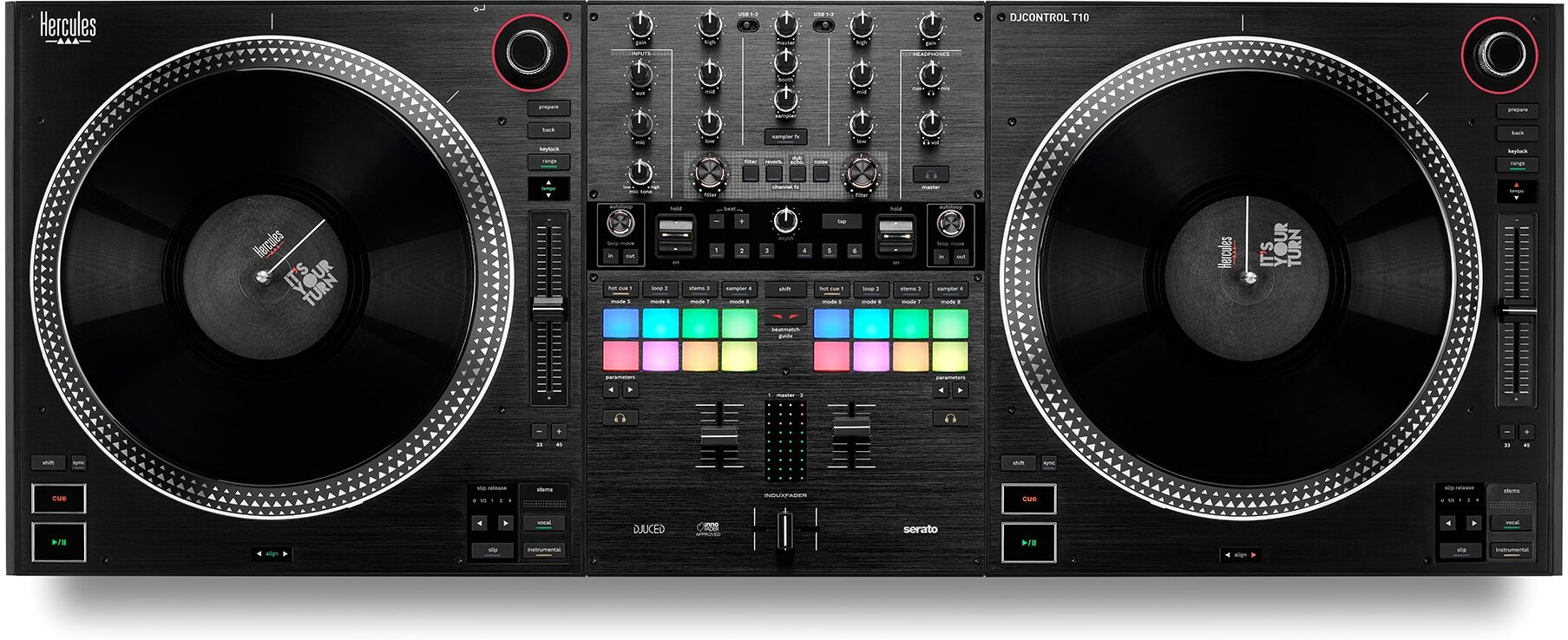
For years, the rule with motorized controllers has been simple: you get spinning platters, but they’re 7 inches, and your hands have to adjust. The Hercules DJControl T10 breaks that rule. It’s the first DJ controller to put full 10-inch motorized platters under real vinyl, and it does it for $1,399 — $300 less than the Rane One MKII in the US.
That’s a big claim to live up to, especially from a brand best known for entry-level gear. So is the Hercules DJControl T10 a serious scratch controller, or a beginner unit with oversized wheels? The answer sits somewhere in between, and which side of that line matters to you depends on how long you plan to keep it.
Hercules DJControl T10 at a Glance
| Price | $1,399 / £1,199 / €1,299 |
| Platters | 2 x 10″ motorized metal platters, belt-driven, servo-controlled |
| Crossfader | InduXfader (contactless, Innofader-approved) |
| Software | Serato DJ Pro + Pitch ‘n Time DJ, DJUCED PRO (both included) |
| Channels | 2 |
| Pads | 16 RGB performance pads |
| Outputs | Balanced XLR master, RCA master, balanced 1/4″ booth |
| Inputs | 1 mic, 1 aux |
| Computer connections | 2 x USB-C |
| Weight | 16.1 lb (7.3 kg) |
| Dimensions | 37.4 x 13.9 x 3.7 in (feet folded) |
| Standalone? | No — laptop required |
Quick verdict: The Hercules DJControl T10 delivers on its headline feature. The platters, the crossfader, and Stem Slip are the real deal. The trade-off is build quality — it’s lighter and more plastic than the Rane One MKII, and a few controls feel built to a budget.
What Is the Hercules DJControl T10?
Hercules first showed the T10 at NAMM in January 2026 as a prototype under glass, and it’s now shipping. It’s a two-channel, laptop-based controller built for scratch, battle, hip-hop, and open-format DJs — the same crowd the Rane One MKII targets.
It’s the successor to the Hercules DJControl Inpulse T7, which introduced 7-inch motorized platters to the Hercules lineup. The T10 scales that concept up considerably. Hercules developed it in collaboration with Serato, UDG, and Dr. Suzuki, and that list tells you where the design priorities landed: software integration, transport, and slipmat feel.
The mixer layout borrows heavily from battle mixers. Hands-on reviewers have compared the central section to the Pioneer DJ DJM-S7, and it’s an apt comparison — the controls are spread out, with room for fast fader work.
The 10-Inch Motorized Platters
This is the reason the Hercules DJControl T10 exists, so it’s worth getting into how they work.
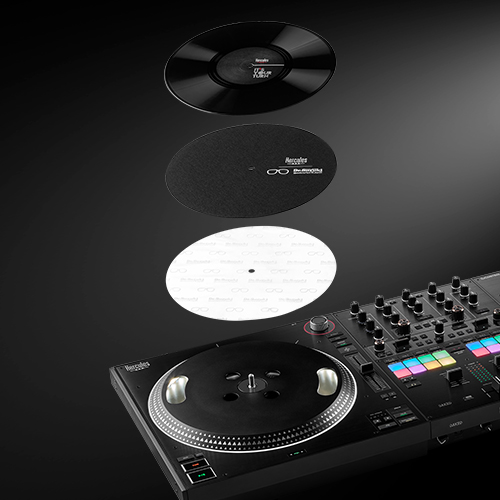
Each platter is driven by a brushless motor through a belt. A sensor monitors rotation continuously, and a microcontroller corrects speed deviations in real time. Hercules quotes 0.16 Nm of starting torque, with the platter reaching full playback speed in under 100 milliseconds.
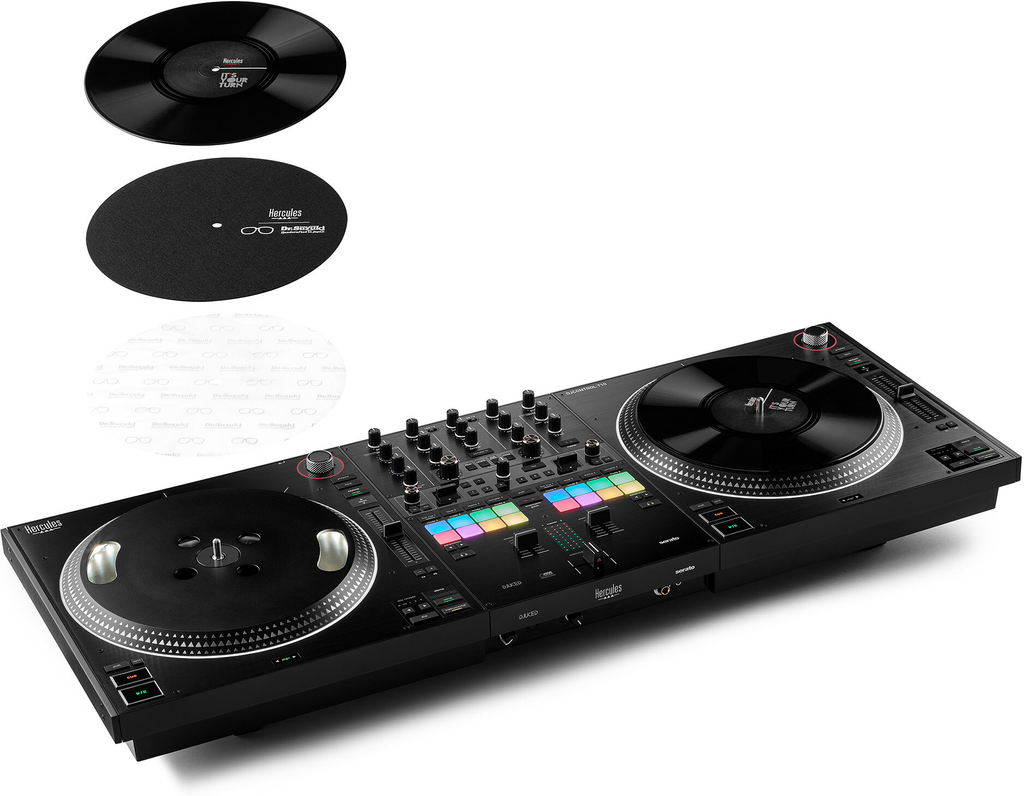
On top of each platter sits a real 10-inch disc with an officially licensed Dr. Suzuki felt slipmat and slipsheet. That combination is a big part of the feel. Dr. Suzuki mats are a standard among scratch DJs, and getting them in the box saves you around the cost of an upgrade you’d likely make anyway.
Why 10 inches matters
Most motorized controllers — the Rane One MKII, the Pioneer DJ DDJ-REV7, the Hercules T7 — use platters around 7 inches. That works, but it forces an adjustment if you learned on 12-inch turntables. Your hand positions are compressed, and techniques like tears, chirps, and transformer-style cuts need tighter motion.
At 10 inches, you’re much closer to the real thing. Early hands-on reports from NAMM described the platters as tight and responsive with solid torque, and reviewers with larger hands called out the extra real estate as a genuine benefit. If you split time between a controller and a turntable setup, a closer match in size means less recalibrating between the two.
Belt drive, not direct drive
Be clear on what you’re getting: this is a belt-driven system, which is standard for motorized controllers because it keeps weight and cost down. It’s not a direct-drive Technics. The servo correction is designed to keep speed stable under hand pressure, but DJs coming from high-torque direct-drive decks should expect a lighter pull.
InduXfader and the Battle-Style Mixer
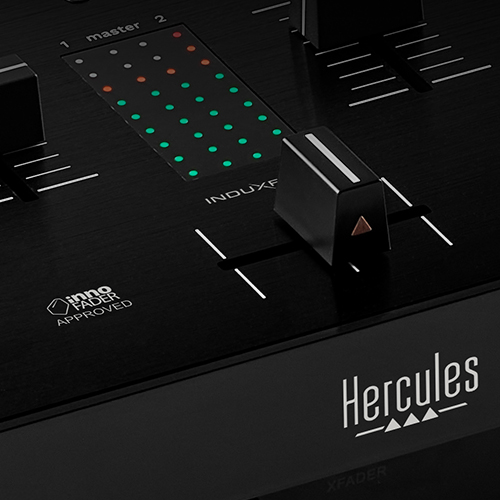
The crossfader is the other standout. Hercules’ InduXfader is contactless — it uses electromagnetic induction rather than physical contacts, so there’s no mechanical wear point in the signal path. It’s also Innofader-approved, which is a meaningful endorsement for a scratch fader.
You can adjust four parameters:
- Weight — how heavy or light the fader feels under your fingers
- Curve — from a sharp cut for scratching to a gradual blend for mixing
- Cut lag — how far the fader travels before the sound cuts in
- Direction — hamster switch for reversed fader operation
Hands-on reviews have rated the crossfader as excellent, and it’s one of the areas where the Hercules DJControl T10 punches well above the Hercules name.
Each channel gets gain, a 3-band EQ, a filter, and a USB selector switch. The deck sections include Play, Cue, Sync, Shift, and a tempo fader with range and pitch bend controls.
Stems and Stem Slip: What’s Actually New
Stems controls are now expected on any serious Serato controller, and the Hercules DJControl T10 has dedicated stem buttons on each deck. You can isolate or mute vocals and instrumentals live without digging through pad modes.
The feature that’s genuinely new is Stem Slip, powered by Serato. Slip mode itself isn’t new — it keeps the track playing in the background while you scratch, then drops you back in at the right spot when you let go. Stem Slip applies that logic at the stem level, returning the stem track to its correct position after you scratch it.
In practice, that opens up routines where you manipulate one element of a track while keeping everything locked to the beat when you release. It’s a genuine first for Serato, and it’s the kind of feature that could show up on other hardware later — but right now, the T10 is where you’ll find it..
There’s also Serato Slip Release control built directly into the hardware, so you’re not reaching for a laptop to toggle it.
Performance Pads and FX Paddles
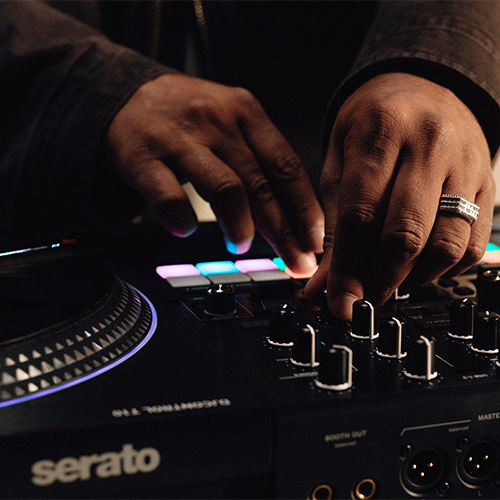
The T10 has 16 RGB performance pads — eight per deck — covering hot cues, loops, slicer, and sampler modes. The pad lighting is adjustable, which helps in dark booths and bright outdoor gigs alike.
The FX paddles give you instant access to effects like reverb, filter, and dub echo. This is where the budget shows. Hands-on reviews have found the paddles feel cheap and inconsistently built, which is a notable criticism given that paddles take a lot of fast, repeated hits during a routine. If you lean hard on paddle FX, try one in person before you buy if you can.
Worth noting: the effects here are Serato’s software FX. Unlike the Rane One MKII, which added onboard hardware effects with the MKII update, the T10 doesn’t process external sources through internal FX.
Software: Serato DJ Pro, Pitch ‘n Time, and DJUCED PRO
The software bundle is strong. The Hercules DJControl T10 includes:
- Serato DJ Pro license
- Pitch ‘n Time DJ expansion
- DJUCED PRO, Hercules’ own software
The Pitch ‘n Time inclusion is a bigger deal than it looks. When the T10 was first announced, there were real concerns it would ship without it, which would have locked out proper key adjustment in Serato unless you paid for an upgrade. Hercules included it, and that removes a hidden cost.
If you already DJ with Serato DJ Pro on a DVS setup, you can move to the T10 without changing software or rebuilding your library. That’s a practical advantage for turntablists who want a lighter setup for certain gigs.
Streaming support covers Apple Music, Beatport, SoundCloud, Spotify, and TIDAL. For more on how streaming works across platforms, see our DJ streaming integration guide.
DJUCED PRO adds set recording, custom controller mapping, and video loops. It’s a capable backup, but most buyers of this controller will live in Serato.
No standalone mode
The T10 needs a laptop. There’s no onboard screen or internal computer. If you want motorized platters without a laptop, the Rane System One is the standalone option — but it costs $1,100 more and uses 7.2-inch platters.
Connectivity and Audio
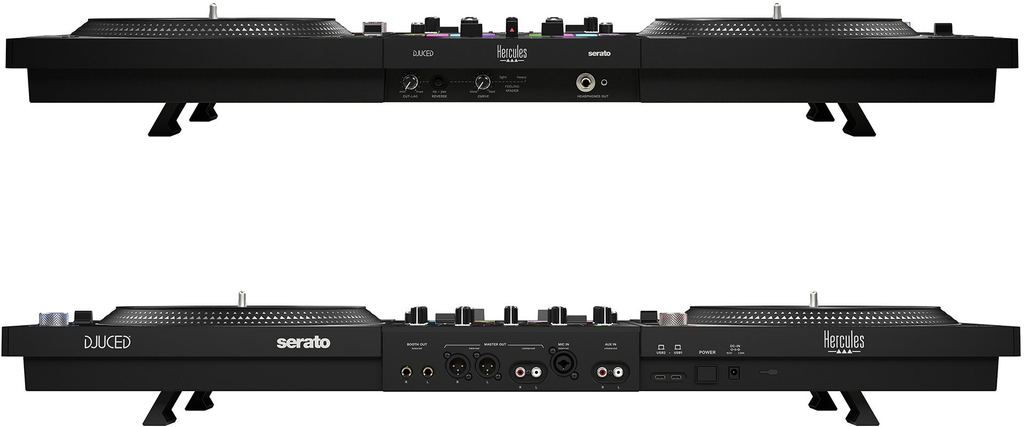
For a laptop-based unit, the I/O is generous:
- 2 x balanced XLR master outputs (+28 dBu)
- 2 x RCA master outputs (+7 dBu)
- 2 x balanced 1/4″ booth outputs (+28 dBu)
- Microphone input
- Auxiliary input
- 2 x USB-C for two computers
The balanced XLR and booth outputs mean you can plug straight into a club mixer or a PA system without adapters. The dual USB-C ports let two DJs connect laptops at once and hand off mid-set without stopping the music — useful for back-to-back sets and shared-booth nights.
A few trade-offs to flag. The audio interface runs at 44.1 kHz / 24-bit, which is fine for club playback but not a spec-sheet highlight. There’s only one mic input, where the Rane One MKII gives you two XLR/TRS combo inputs. And there are no phono inputs, so you can’t route real turntables through the T10 as a mixer.
Build Quality, Size, and Portability
This is where the Hercules DJControl T10 makes its biggest compromise.
The chassis is mostly plastic with metal top plates. Hercules reinforced the edges with panels so it doesn’t feel flimsy, and the lighter construction keeps the weight at 16.1 lb (7.3 kg) — far easier to carry than two turntables and a battle mixer. Retractable non-slip feet let you adjust the height on different surfaces.
The honest criticism from hands-on reviews is that it doesn’t inspire the same long-term confidence as gear built to last a decade. The Rane One MKII, by comparison, is built to a standard you’d expect to still be working in five to ten years. For a controller you’ll scratch on hard, build quality isn’t a minor detail.
Check your booth space
Those 10-inch platters make for a wide unit: 37.4 inches across with the feet folded. That’s close to the width of a traditional two-turntable setup. Before you buy, measure your usual booth, table, or coffin case. Some DJ tables and older coffins won’t fit it.
On transport: early announcement coverage listed a custom UDG bag as part of the package, but at least one retailer lists the UDG bag as a separate purchase. Confirm what’s in the box with the seller before you order.
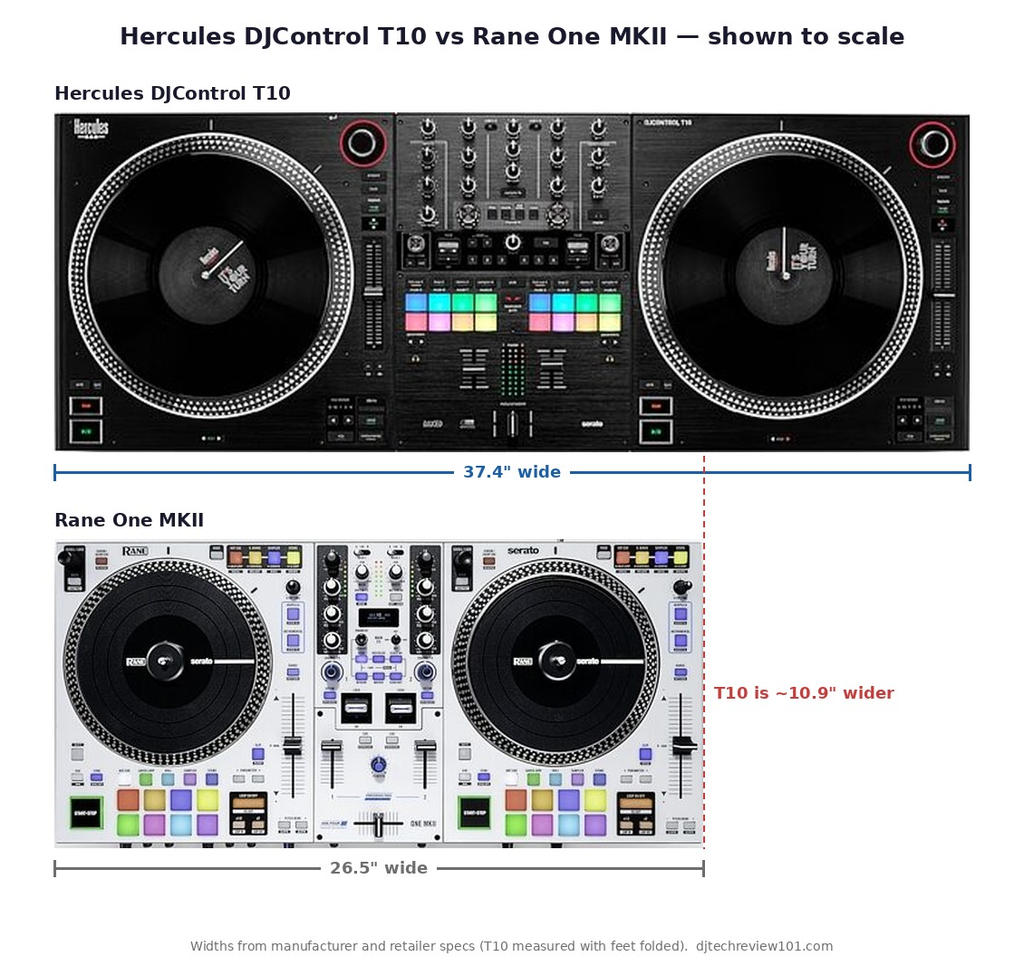
Hercules DJControl T10 vs Rane One MKII
This is the comparison most buyers will be weighing, and it’s close.
| Hercules DJControl T10 | Rane One MKII | |
|---|---|---|
| US price | $1,399 | $1,699 |
| Platter size | 10″ | 7.2″ |
| Crossfader | InduXfader (contactless) | MAG FOUR |
| Stem Slip | Yes | No |
| Hardware FX | No | Yes (29 internal FX) |
| Mic inputs | 1 | 2 |
| Line/phono inputs | Aux only | 2 line/phono |
| Build | Plastic with metal top plates | Heavier, pro-grade build |
| Software | Serato DJ Pro + Pitch ‘n Time, DJUCED PRO | Serato DJ Pro |
Choose the T10 if platter size is your priority, you want Stem Slip, or you’d rather keep $300 in your pocket.
Choose the Rane One MKII if you’re buying for durability, you need hardware FX on external sources, or you want to plug turntables or two mics into the unit. Our full Rane One MKII review covers it in detail.
In the UK, the price gap is only around £100, which pushes the argument toward the Rane. In the US, the $300 gap makes the T10 a stronger value case.
What About the Hercules T7 and Pioneer DDJ-REV7?
The Hercules DJControl Inpulse T7 is the T10’s predecessor, with 7-inch motorized platters at a much lower price. If you’re new to scratching and want to learn on motorized platters without spending $1,400, the T7 is the more sensible starting point.
The Pioneer DJ DDJ-REV7 is the other established motorized option, with 7-inch platters and a battle layout. It’s a proven unit, but it lacks the deep stems integration that both the Rane One MKII and the T10 offer.
If you’d rather skip platters entirely and go for a jog-wheel controller, our Traktor MX2 review covers a very different approach.
Pros and Cons
Pros
- Only controller with 10-inch motorized platters
- Excellent contactless InduXfader with full adjustment
- Stem Slip is a genuine first for Serato
- Serato DJ Pro, Pitch ‘n Time, and DJUCED PRO all included
- Dr. Suzuki slipmats and slipsheets in the box
- Balanced XLR and booth outputs, dual USB-C for handovers
- $300 less than the Rane One MKII in the US
Cons
- Mostly plastic build; less confidence in long-term durability
- FX paddles feel cheap and inconsistent
- Very wide — 37.4 inches — so check your booth space
- Only one mic input and no phono inputs
- No hardware FX, no standalone mode
- 44.1 kHz audio interface
Who Should Buy the Hercules DJControl T10?
Good fit:
- Turntablists who want a lighter gig setup that still feels close to 12-inch vinyl
- Scratch and battle DJs frustrated with 7-inch platters
- Open-format and hip-hop DJs who want to build routines around stems
- Serato DVS users who want to switch to a controller without changing their library
Skip it if:
- You want a controller that will survive years of heavy touring abuse — the Rane One MKII is the safer bet
- You need to run turntables or multiple mics through your controller
- You want to DJ without a laptop — look at the Rane System One
- You’re a beginner on a tight budget — the Hercules T7 does the job for far less
Buyer’s Takeaway
The Hercules DJControl T10 gets the important things right. The 10-inch platters close the gap between controller and turntable in a way no other unit does, the InduXfader is excellent, and Stem Slip gives you a routine-building tool you can’t get elsewhere yet. The software bundle is complete, with no hidden upgrade costs.
What you give up is build quality. The T10 is lighter and more plastic than its main rival, and the FX paddles in particular don’t match the rest of the controller. For a DJ who scratches hard every weekend for years, that matters.
Our take: if platter size is what’s held you back from motorized controllers, the Hercules DJControl T10 is the one to try. If you want the most durable all-rounder at this price, spend the extra $300 on the Rane One MKII.

For full specs straight from the manufacturer, visit the official Hercules DJControl T10 page.
Would 10-inch platters get you to switch from a jog-wheel controller, or is build quality the bigger deal-breaker for you? Let us know in the comments.